---
section: about
lead: true
title: Project portfolio
authors:
- Neil Ashton
---
Here are some of the projects, past and present, that we have been involved with.
* Current OpenSpending projects
* Past projects
* Tools for governments
* Government use cases
* Publications and reports
* Technical standards
* Stories and data journalism
* Collaborate! Your project here...
## Current projects
We're working on [OpenSpending Next](/next/), the next version of OpenSpending. Learn how to [get involved](/get-involved/)!
## Already unleashed
#### Spending Stories
In 2011, the Open Knowledge Foundation was awarded a Knight News Challenge Grant to work on the Spending Stories Project. Large numbers are often meaningless to the general public, and despite a wealth of information around government spending, the topic of government finance is often overlooked by journalists. The Spending Stories project aims to facilitate reporting by speeding up fact-checking around spending data as well as connecting news stories about public spending to relevant datasets and visualisations to put these stories into context.
We're into our second year of the project now. See what we are up to by following our updates on the PBS Idea Lab blog.
#### budzeti.ba: Bosnian Budget Bubbles
 In October 2013 OpenSpending launched the "Where Does My Money Go"-site budzeti.ba in Bosnia and Herzegovina. Thanks to a grant from the National Endowment for Democracy, the OpenSpending team collaborated with the Centre for Public Interest Advocacy in Bosnia to produce interactive graphics of national and subnational budgets in Bosnia.
As part of the project OpenSpending:
In October 2013 OpenSpending launched the "Where Does My Money Go"-site budzeti.ba in Bosnia and Herzegovina. Thanks to a grant from the National Endowment for Democracy, the OpenSpending team collaborated with the Centre for Public Interest Advocacy in Bosnia to produce interactive graphics of national and subnational budgets in Bosnia.
As part of the project OpenSpending:
- Created visualisations of national, entity-, cantonal- and district-level budgets for Bosnia.
- Conducted onsite trainings and capacity building workshops with organisations from other Balkan countries, on getting, wrangling and presenting financial data (with OpenSpending and other tools).
- Developed a tax calculator for Bosnia (similar to the Daily Bread).
- Tested the Spending Data Handbook and added an OpenSpending guide with a more technical guidance, for those organisations wishing to do more ambitious data work.
Read more about the project. Read the full announcement from the launch.
#### OpenSpending Slovakia
In early 2013, we launched Slovakia Openspending, prepared in collaboration with transparency and anti-corruption watchdog Transparency International Slovakia. The site contains budget and expenditure information gathered from some 20 cities across Slovakia allowing users to examine current municipality budgets and compare them to expenditures going back to 2009. Based on the openspending.org source code, we have added several improvements such as:
- Year-on-year comparison for spending categories.
- Improved listing and more contextual presentation of the data.
- Embedable graphic drilldowns with accompanying tables.
Transparency Slovakia hopes to promote the site as an example of how budgets could be made more accessible and comprehensible to the public once the site is localized and tested further. While not in its current plans, additional spending data and a feature to allow users to compare cities would improve opportunities for doing crowdsourced benchmarking.
#### Where Does My Money Go?
 Where Does My Money Go? (WDMMG) is the project from which OpenSpending was born. Funded originally by 4IP, it allows UK citizens to examine where their taxes are being spent through an interactive 'bubble tree' visualisation. They can even find out how much they contribute on a daily basis through their taxes to various sectors of society through the Daily Bread app.
You can now build a site like WDMMG for your own country using the OpenSpending API and the WDMMG Toolkit:
#### Cameroon Budget Inquirer
Where Does My Money Go? (WDMMG) is the project from which OpenSpending was born. Funded originally by 4IP, it allows UK citizens to examine where their taxes are being spent through an interactive 'bubble tree' visualisation. They can even find out how much they contribute on a daily basis through their taxes to various sectors of society through the Daily Bread app.
You can now build a site like WDMMG for your own country using the OpenSpending API and the WDMMG Toolkit:
#### Cameroon Budget Inquirer
 We collaborated with the World Bank to produce a citizen-friendly representation of Cameroon's budget.
The project incorporates the open-source 'bubble visualisations' first seen in Where Does My Money Go, as well as many new elements, such as a map based navigation and heatmaps. The project includes:
We collaborated with the World Bank to produce a citizen-friendly representation of Cameroon's budget.
The project incorporates the open-source 'bubble visualisations' first seen in Where Does My Money Go, as well as many new elements, such as a map based navigation and heatmaps. The project includes:
- Visualisation of the National Investment Budget, the Northwest region's budget of Cameroon (including absolute and per-capita estimates, budgeted as well as actual figures) as well as a similar visualisation of the Tignere local council budget.
- A sub-national budget transparency index - similar to the work of the International Budget Partnership, but at sub-national levels. This highlights the availability of key budget documents and ranks regions on their availability.
- Explore the data: filter the data by categories such as amount, location, and activity.
#### OffenerHaushalt
 OffenerHaushalt allows users to explore and drill down through the various layers of Germany's federal budget, comparing data from as far back as 2006. Through the new TreeMap visualisation, the user can easily see and explore the different departments and programmes and see how much is spent, proportions and statistics on changes between years.
The success of OffenerHaushalt and the demand to roll it out on a local level was one of the prime motivations for the creation of OpenSpending. To date, the OffenerHaushalt team have received around 90 requests for a similar site in their area.
#### Uganda Aid Visualisation
Aid flows often do not pass through a recipient government’s conventional budget mechanisms. When this happens, recipient governments themselves may not have the complete overview of where aid money goes and how donor priorities align with their own. This information is vital for governments and aid donors to be able to make the best use of scarce resources.
OffenerHaushalt allows users to explore and drill down through the various layers of Germany's federal budget, comparing data from as far back as 2006. Through the new TreeMap visualisation, the user can easily see and explore the different departments and programmes and see how much is spent, proportions and statistics on changes between years.
The success of OffenerHaushalt and the demand to roll it out on a local level was one of the prime motivations for the creation of OpenSpending. To date, the OffenerHaushalt team have received around 90 requests for a similar site in their area.
#### Uganda Aid Visualisation
Aid flows often do not pass through a recipient government’s conventional budget mechanisms. When this happens, recipient governments themselves may not have the complete overview of where aid money goes and how donor priorities align with their own. This information is vital for governments and aid donors to be able to make the best use of scarce resources.
 Normally this overview is not available – leading to waste, overlap and inefficiency. The lack of comparable information means aid donors and recipient country governments can’t work together to coordinate their efforts or understand how donor priorities align with recipient priorities; it decreases developing country governments' ownership and undermines the potential for good governance and planning. Donors and governments need to know what others are doing - and crucially, what others are planning on doing - if they are to make sure that these resources are used most effectively. Otherwise, some sectors and areas will not receive enough funding, while others may have too many donors involved.
The Uganda Aid visualisation project was a joint project between the OKFN and Publish What You Fund to combine two key types of fiscal data, revenues from aid together with spending information, and present them together in an informative way for the first time through an interactive visualisation.
#### IATI
The International Aid Transparency Initiative is a common format for publishing aid information. 29 signatories representing 75% of global Official Development Finance have committed to reporting timely information about their aid activities in this standard format. Already, 13 signatories representing 45% of ODF have published.
Normally this overview is not available – leading to waste, overlap and inefficiency. The lack of comparable information means aid donors and recipient country governments can’t work together to coordinate their efforts or understand how donor priorities align with recipient priorities; it decreases developing country governments' ownership and undermines the potential for good governance and planning. Donors and governments need to know what others are doing - and crucially, what others are planning on doing - if they are to make sure that these resources are used most effectively. Otherwise, some sectors and areas will not receive enough funding, while others may have too many donors involved.
The Uganda Aid visualisation project was a joint project between the OKFN and Publish What You Fund to combine two key types of fiscal data, revenues from aid together with spending information, and present them together in an informative way for the first time through an interactive visualisation.
#### IATI
The International Aid Transparency Initiative is a common format for publishing aid information. 29 signatories representing 75% of global Official Development Finance have committed to reporting timely information about their aid activities in this standard format. Already, 13 signatories representing 45% of ODF have published.
 IATI publishers release the data as open data feeds in a common XML format through their own websites. They then register their data with the IATI Registry - which runs on the Open Knowledge Foundation's CKAN software - making it easy for users to find this data.
However, the nature of IATI as a distributed collection of raw data feeds also presents a challenge to non-technical users. The Open Knowledge Foundation worked with Publish What You Fund to transform the data into a format suitable for import into OpenSpending, where the data can be much more easily visualised and analysed.
View the IATI data on OpenSpending
## Tools for governments
#### Data.Gov.Uk Spend Browser
IATI publishers release the data as open data feeds in a common XML format through their own websites. They then register their data with the IATI Registry - which runs on the Open Knowledge Foundation's CKAN software - making it easy for users to find this data.
However, the nature of IATI as a distributed collection of raw data feeds also presents a challenge to non-technical users. The Open Knowledge Foundation worked with Publish What You Fund to transform the data into a format suitable for import into OpenSpending, where the data can be much more easily visualised and analysed.
View the IATI data on OpenSpending
## Tools for governments
#### Data.Gov.Uk Spend Browser
 The OpenSpending team worked with Data.Gov.Uk to build the transaction explorer which forms part of the Data.Gov.Uk website.
The transaction explorer allows any user to directly search the OpenSpending database for companies, departments or projects of interest and investigate how much money was spent on them.
#### UK Government Spend Reporting Dashboard
The OpenSpending team worked with Data.Gov.Uk to build the transaction explorer which forms part of the Data.Gov.Uk website.
The transaction explorer allows any user to directly search the OpenSpending database for companies, departments or projects of interest and investigate how much money was spent on them.
#### UK Government Spend Reporting Dashboard
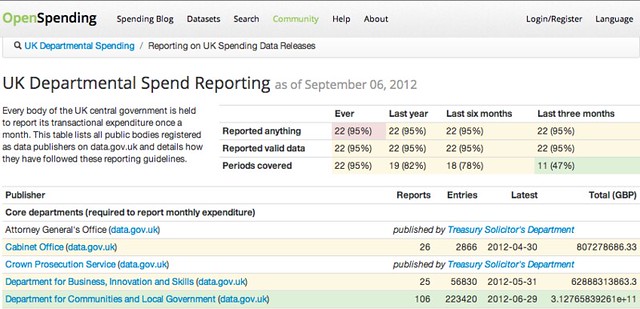 The OpenSpending team worked with Data.Gov.Uk to produce an automatic reporting tool to demonstrate which government departments were complying with their transparency obligations.
The tool lists departments registered as data publishers on data.gov.uk and details how precisely they have followed the HM Treasury reporting guidelines. It will also make the whole of the reported data available for search and analysis both on data.gov.uk and on the OpenSpending site.
## Government use cases
#### City of Bologna
The OpenSpending team worked with Data.Gov.Uk to produce an automatic reporting tool to demonstrate which government departments were complying with their transparency obligations.
The tool lists departments registered as data publishers on data.gov.uk and details how precisely they have followed the HM Treasury reporting guidelines. It will also make the whole of the reported data available for search and analysis both on data.gov.uk and on the OpenSpending site.
## Government use cases
#### City of Bologna
 The open data team at the City of Bologna uses OpenSpending to visualise several years of the city budget.
#### City of Berlin
The open data team at the City of Bologna uses OpenSpending to visualise several years of the city budget.
#### City of Berlin
 The City of Berlin asked Open Knowledge Foundation Germany to visualise the budget for the city using OpenSpending. The result is featured on the site for the city finances.
## Publications and Reports
#### Technology for Transparent & Accountable Public Finance
The City of Berlin asked Open Knowledge Foundation Germany to visualise the budget for the city using OpenSpending. The result is featured on the site for the city finances.
## Publications and Reports
#### Technology for Transparent & Accountable Public Finance
 The report, “Technology for Transparent and Accountable Public Finance”, was commissioned by the Global Initiative for Fiscal Transparency (GIFT) in February 2012 in order to assist GIFT in assessing the potential of technology to aid transparency and accountability in relation to governments’ fiscal activities.
Read the recommendations.
Download as PDF
#### Mapping the Open Spending Data Community
The report, “Technology for Transparent and Accountable Public Finance”, was commissioned by the Global Initiative for Fiscal Transparency (GIFT) in February 2012 in order to assist GIFT in assessing the potential of technology to aid transparency and accountability in relation to governments’ fiscal activities.
Read the recommendations.
Download as PDF
#### Mapping the Open Spending Data Community
 In early 2012, we set out on a mission. Our aim was to establish how CSO's currently work with spending data, how they would like to use it, and what they would like to achieve - including:
- what existing tools are being used
- what current technical needs are unmet
- what would be required to meet these needs and how feasible is it to tackle them
This report is the output of that research. Here, we bring together key case studies from organisations who have done pioneering work in using technology to put government data to best use.
In this report we:
- outline how the data could be improved in order to make it more usable
- examine some key case studies of how organisations are using technology to do groundbreaking research, citizen engagement, visualisation and tracking of accountability.
- talk about the training needs for CSO's to help them better use the data available, and to demand better data.
Read the conclusions.
Athens to Berlin research trip: Watch the video interviews
#### The Spending Data Handbook
 The Spending Data Handbook is addressed to people and organisations who want to use and understand government budgets and spending data in their work.
The book covers:
The Spending Data Handbook is addressed to people and organisations who want to use and understand government budgets and spending data in their work.
The book covers:
- Collaborating with other organizations to pool resources and strengthen your advocacy effort
- If you're just starting out, what data to look for and what to ask for (nay, demand!) from your government
- The 'Data Pipeline': Tricks and tips for finding, wrangling and systematically processing your data
- Getting ambitious, running a technology project
- Presenting your findings to engage the public, media and government
- Lists and appendices of technical and non-technical resources
## Standards
#### [Draft] Standard for Transaction-level Spending Data
The release of transaction-level data (i.e. information about individual disbursements or contract spending) is a relatively new idea, compared to the release of higher-level accounting information or budget overviews. The availability of such data allows for fine-grained analysis and oversight of activities and will, in the future, enable anyone inside or outside of government to reconstruct key reports from raw data. In order to perform these types of analysis, it is often necessary to combine spending information from several sources - either for completeness or comparison.
Too often, standardization in this context appears to be supply-driven: every publisher wants to express the full range of data they hold and are willing to release. Necessarily, such an approach leads to a standard that is the superset of all the systems that feed into it.
Such designs tend to be of little use to the intended consumers, as they raise the barriers to understanding the information considerably. Our approach therefore is to generate demand-side use cases first, ensuring that everything that is done will generate value for data users.
Read our proposed standard.
## Stories and Data Journalism
#### The Guardian (UK)
The Real Price of the London Olympics
 The Guardian used OpenSpending's bubbletree visualisations to answer the questions: Where is the Olympics money coming from - and where's it being spent? How much is coming from sponsorship - and how much does the Olympic stadium cost?
See the interactive visualisation on the Guardian Datablog.
The Guardian used OpenSpending's bubbletree visualisations to answer the questions: Where is the Olympics money coming from - and where's it being spent? How much is coming from sponsorship - and how much does the Olympic stadium cost?
See the interactive visualisation on the Guardian Datablog.
The Daily Bread
The Daily Bread from Where Does My Money Go? Has made regular appearances on the Guardian Datablog around budget time in the UK.
#### Le Monde (France)
We experienced an extremely high traffic spike when a visualisation based on French data was featured in Le Monde in October 2012.
The article PLF : des avions au bouclier fiscal, la java des amendements, (PLF=Projet de loi de finances, the draft finance law) deals with suggested amendments to the draft finance law and which parties were demanding what amendments.
The OpenSpending visualisation used in the article is intended to give a high-level representation of some of the main areas of government expenditure in France.
#### Politiken (Denmark)
 Municipalities are central for the functioning of the welfare state Denmark. They take care of a range of important tasks like social- and health care, primary education, social benefits, traffic and much more. Even in a year with local elections, however, they do not attract much public attention. The open data web agency Buhl-Rasmussen developed a site of all 98 Danish municipalities for one of the biggest Danish news sites, Politiken.
#### Sumy News, Ukraine
Municipalities are central for the functioning of the welfare state Denmark. They take care of a range of important tasks like social- and health care, primary education, social benefits, traffic and much more. Even in a year with local elections, however, they do not attract much public attention. The open data web agency Buhl-Rasmussen developed a site of all 98 Danish municipalities for one of the biggest Danish news sites, Politiken.
#### Sumy News, Ukraine
 On December 26, 2012, Sumy City Council approved the city budget for 2013, but there were big concerns about how it would be executed.
The expected revenues for the coming year did not appear to match the planned output, as Sumy would have to have generated 15.7% more than the expected revenues in 2012....
Read the article.
#### Privacy International
In early 2012, Privacy International approached the Spending Stories team to ask for a search widget to be able to search across all of the government spending datasets held in OpenSpending. They had a list of companies which exhibited at the famous surveillance technology conferences in the US, the so-called Wiretappers' Ball, as well as a list of attendees of the conference, and they wanted to check which attendees also became customers of these companies.
On December 26, 2012, Sumy City Council approved the city budget for 2013, but there were big concerns about how it would be executed.
The expected revenues for the coming year did not appear to match the planned output, as Sumy would have to have generated 15.7% more than the expected revenues in 2012....
Read the article.
#### Privacy International
In early 2012, Privacy International approached the Spending Stories team to ask for a search widget to be able to search across all of the government spending datasets held in OpenSpending. They had a list of companies which exhibited at the famous surveillance technology conferences in the US, the so-called Wiretappers' Ball, as well as a list of attendees of the conference, and they wanted to check which attendees also became customers of these companies.
 Some attendees posed no surprises – the FBI, the US Drug Enforcement Administration, the UK Serious Organized Crime Agency and Interpol to name a few – but there were a few that are downright baffling, like the US Department of Commerce, the US Fish & Wildlife Service and the Clark County School District Police Department.
As more datasets are loaded into OpenSpending, this universal search will get increasingly more powerful, and we look forward to hearing what other people use the search for.
#### Italian Regional Accounts Data
Some attendees posed no surprises – the FBI, the US Drug Enforcement Administration, the UK Serious Organized Crime Agency and Interpol to name a few – but there were a few that are downright baffling, like the US Department of Commerce, the US Fish & Wildlife Service and the Clark County School District Police Department.
As more datasets are loaded into OpenSpending, this universal search will get increasingly more powerful, and we look forward to hearing what other people use the search for.
#### Italian Regional Accounts Data
 During the International Journalism Festival in Perugia in 2011, the OpenSpending team loaded and visualised the Italian regional accounts for 2008. The project received wide coverage in the Italian and International Press and was one of the earliest success stories for OpenSpending after Where Does My Money Go? went international.
Visit the Italian Regional Accounts on OpenSpending.org.
Coverage of the Italian Regional Accounts Data:
## Training
During the International Journalism Festival in Perugia in 2011, the OpenSpending team loaded and visualised the Italian regional accounts for 2008. The project received wide coverage in the Italian and International Press and was one of the earliest success stories for OpenSpending after Where Does My Money Go? went international.
Visit the Italian Regional Accounts on OpenSpending.org.
Coverage of the Italian Regional Accounts Data:
## Training
 We regularly conduct training sessions for journalists and NGOs on how to locate, extract, work with and visualise spending and other types of data. If you are interested in exploring these possibilities, please [get in touch](/about/contact/).
You can find more of our training materials on the School of Data website.
## Community
We regularly conduct training sessions for journalists and NGOs on how to locate, extract, work with and visualise spending and other types of data. If you are interested in exploring these possibilities, please [get in touch](/about/contact/).
You can find more of our training materials on the School of Data website.
## Community
 The OpenSpending community includes engaged citizens, dedicated journalists and members of civil society organisations working on developing best practices around opening up and using government financial data with experts from fields ranging from aid experts, participatory budgeting fields, governmental institutions and civic developer initiatives.
We showcase and display some of the most interesting projects from all over the world on [the OpenSpending blog](/blog/).
The working group is open to everyone with an interest in improving Government Financial Transparency around the world. If you're interested in joining, please join the forums.
## Contribute
#### Your project here
Have some data? Have a Spending Story? Get in touch - we'd love to hear from you and are open to suggestions!
The OpenSpending community includes engaged citizens, dedicated journalists and members of civil society organisations working on developing best practices around opening up and using government financial data with experts from fields ranging from aid experts, participatory budgeting fields, governmental institutions and civic developer initiatives.
We showcase and display some of the most interesting projects from all over the world on [the OpenSpending blog](/blog/).
The working group is open to everyone with an interest in improving Government Financial Transparency around the world. If you're interested in joining, please join the forums.
## Contribute
#### Your project here
Have some data? Have a Spending Story? Get in touch - we'd love to hear from you and are open to suggestions!